


The current Magical Toolz Universal Image Converter does not accept HEIC. Its file picker and decoder support browser-readable PNG, JPEG, WebP, GIF, AVIF and BMP sources. Do not upload a HEIC expecting the extension alone to work.
Use an operating-system app or editor that explicitly opens HEIC and exports WebP. If it can only export JPG or PNG, make that intermediate carefully and keep the original HEIC.
HEIC support must be real, not listed in marketing text
HEIC is commonly used for images encoded with HEVC inside a high-efficiency container. Apple identifies public.heic as its HEIC type in AVFoundation documentation.
A browser tool needs a compatible decoder or a specialist library. Changing .heic to .webp does not convert the bytes. A successful tool should show a correct preview, dimensions and orientation before offering an output.
Why the inactive route should not be used
The old article linked to /webp-to-heic-converter, which is not a working tool record and points in the opposite direction. That route is not a valid HEIC-to-WebP workflow.
The active Universal Converter also states in its interface that HEIC output and input are not claimed. Use it only after a HEIC-capable application has created a supported PNG or JPEG intermediate.
Choose direct conversion when possible
A direct HEIC-to-WebP export avoids an unnecessary lossy JPG stage. Open the HEIC in a current photo application, verify the rendered image, then choose WebP if the application offers it.
- Duplicate the HEIC and keep the original.
- Open it with a verified HEIC decoder.
- Check orientation, crop, color and brightness.
- Select WebP output if available.
- Keep original dimensions unless resizing is required.
- Choose lossy or lossless mode based on the image.
- Decide whether metadata should remain.
- Export, reopen and test the WebP at its destination.
Use an intermediate only when necessary
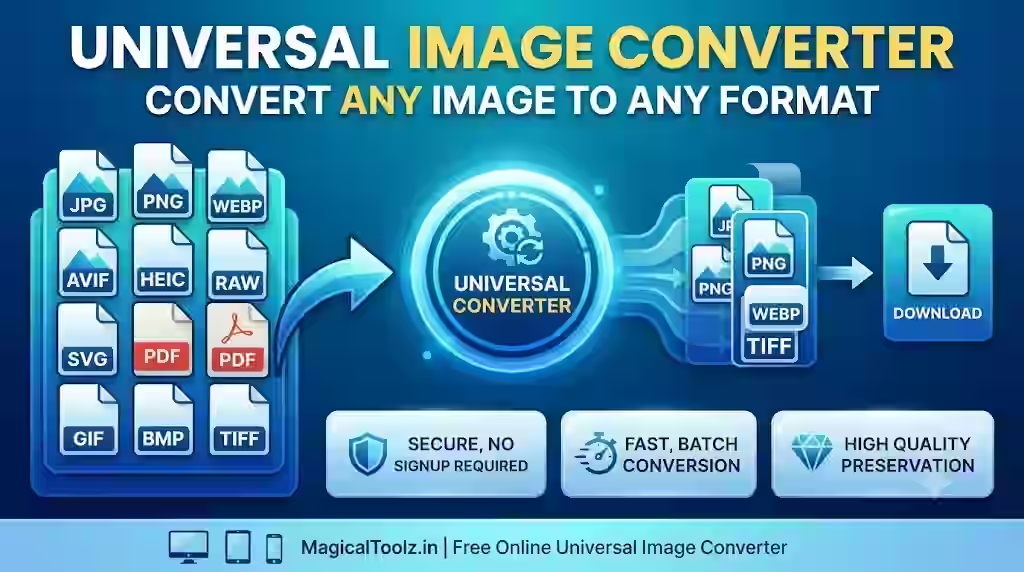
If your HEIC app exports PNG but not WebP, PNG is a useful intermediate because it avoids JPEG loss. It can be large. Export PNG, then use the Universal Image Converter to create one WebP.
If the app only exports JPG, use a high practical quality and avoid repeated saves. The later WebP will be encoded from pixels that already passed through JPEG compression. Keep the HEIC as the source for future conversions.
Check Live Photos and image sequences
An iPhone Live Photo is not just one HEIC file acting as an animation. It combines a still image with a short video asset. Exporting the still to WebP does not preserve the Live Photo experience.
HEIC containers can also carry image sequences and related metadata. Apple's HEIC image properties include sequence timing and loop fields. Use sequence-aware software if motion or multiple images matter.
Orientation and crop errors are common
A phone may store orientation as metadata or an image transform. A decoder should apply it before export. Confirm that portrait photos remain upright and that width and height are not swapped.
Compare all four edges. Some conversion paths apply edits or crops saved by the Photos library, while others read the underlying original. Decide which version you need before export.
Color and HDR may change
HEIC can carry wide color or high dynamic range content. A basic export may map it into a standard-range WebP. Bright highlights, deep shadows and saturated colors can change even when the result looks acceptable at first glance.
Inspect skin tones, skies, lights and gradients on the target device. Use color-managed desktop software when appearance must match a professional source.
Pick WebP settings for the destination
WebP supports lossy and lossless images plus transparency. Google documents these modes in its WebP format guide. A normal phone photo often suits lossy WebP, while a graphic or cutout may need lossless output or alpha.
Resize to the largest display width first. Then compare two or three quality settings. Check the actual byte size and visible detail instead of assuming a fixed saving.
Metadata needs separate verification
HEIC may contain location, capture time, device details and editing information. Some exporters preserve selected fields, while browser Canvas conversion normally omits ordinary metadata.
Inspect the output when privacy, ownership or archive records matter. Keep a written record if metadata removal is required. A new extension is not proof that all private fields are gone.
Pick software by verified input and output support
On macOS, first confirm that the selected app opens the exact HEIC and offers WebP in its export choices. On Windows, HEIC viewing may depend on installed codecs, while WebP export depends on the editor. Viewing support alone does not prove export support.
Test with a copy that is not sensitive. A trustworthy workflow shows the decoded image before conversion and reports errors clearly. Avoid a service that accepts the filename but returns an unrelated format under a WebP extension.
Verify the WebP where it will be used
Open the result in a browser, then upload one sample to the destination. Confirm dimensions, orientation, bytes and color. Some publishing systems convert WebP again or reject it despite browser support.
If compatibility matters more than size, keep a JPG fallback. For a website, confirm that the page requests the WebP rather than an older cached file. Keep the HEIC outside the public delivery folder as the source.
HEIC to WebP questions
Can Magical Toolz open HEIC directly?
No. The current active converter does not include a HEIC decoder.
Can I rename HEIC to WebP?
No. The file must be decoded and encoded into WebP.
Is PNG a better intermediate than JPG?
It avoids added JPEG loss, but it can be much larger.
Will a Live Photo stay live?
No. A still-image export does not preserve the paired video experience.
Should I delete the HEIC?
No. Keep it as the original source.


 MagicalToolz AI Support
Comments (0)
Use comments for article-specific feedback. Use the contact page for bugs and support requests.
Leave a Comment
No comments yet. Be the first to share something useful.