


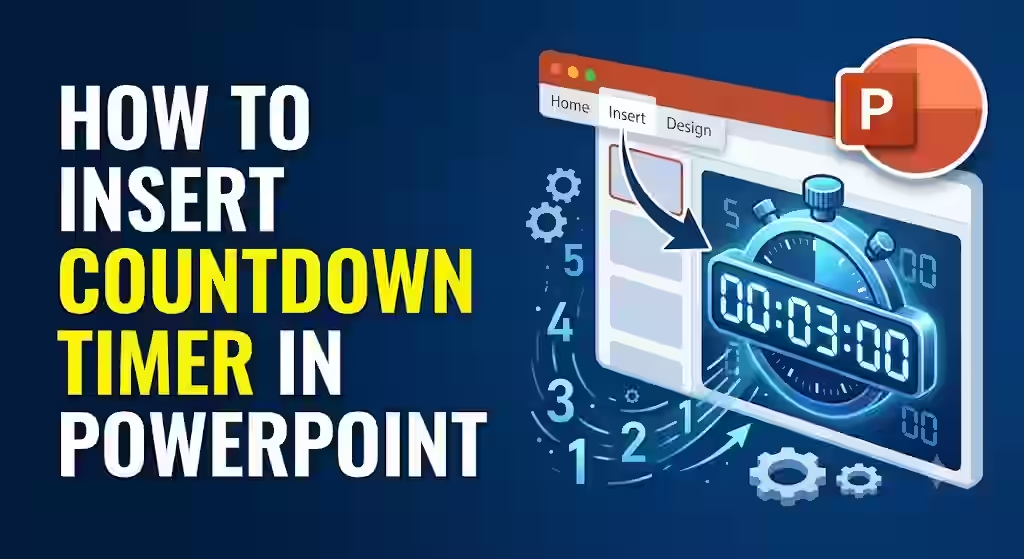
PowerPoint does not require a third-party timer for a simple audience countdown. You can animate numbered text boxes from 5 to 1, or animate a rectangle as a progress bar for a longer activity. Both approaches use normal slide objects and PowerPoint timing controls.
A visible audience timer is different from Presenter View, which helps a speaker monitor presentation time privately. Choose the method based on who needs to see the time and whether the countdown must advance automatically.
Quick answer: For a 5-to-1 countdown, stack five numbered text boxes, add an Exit animation, start 5 on click with a one-second delay, then set 4 through 1 to After Previous with one-second delays. For a longer visual timer, animate a rectangle from the left and set its duration to the required seconds.
Choose the right PowerPoint timer
| Choice | What it means |
| Number countdown | Best when the audience needs exact remaining seconds. |
| Progress bar | Best for a quiet visual indication over 20, 30, or 60 seconds. |
| Timed slide transitions | Useful when an entire slide should advance after a set period. |
| Presenter View timer | Tracks speaking time for the presenter rather than displaying a countdown to the audience. |
| Video timer | Easy to place but may introduce playback, licensing, accessibility, and offline risks. |
| Office add-in | May offer live controls but requires publisher and permission review. |
Create a 5-to-1 animated countdown
- Insert five text boxes and enter 5, 4, 3, 2, and 1.
- Place them in the same location and align their centres.
- Select number 5 and add an Exit animation such as Disappear.
- Apply the same Exit animation to 4, 3, 2, and 1.
- Open Animations, then Animation Pane.
- Set 5 to Start On Click with a one-second delay.
- Set 4 through 1 to Start After Previous with one-second delays.
- Optionally add a Finished message with an Entrance animation after 1.
- Run Slide Show from the current slide and time it with a separate clock.
Follow Microsoft current animation method
Microsoft documents the numbered-text-box sequence and recommends creating the boxes from highest to lowest. Its instructions use an Exit effect, the Animation Pane, and one-second delays to create the sequence.
See Microsoft Support: Create an on-screen timer for the current menu sequence and its progress-bar alternative. The article applies to Microsoft 365, PowerPoint 2024, 2021, 2019, and 2016.
Build a progress bar timer
Insert a rectangle with its left edge at the intended starting point. Apply Fly In, choose From Left, set Start to On Click or After Previous, and set Duration to the number of seconds the activity should last.
A progress bar communicates pace without forcing viewers to read changing numbers. Add a text label such as 30 seconds if the duration is important, and ensure the bar remains visible against the slide background.
Use slide transitions for multi-slide timing
When each question or instruction has its own slide, configure Advance Slide After in the Transitions tab. Disable advance-on-click only if manual navigation would break the activity, then rehearse the complete sequence.
Transitions control slide changes; animations control objects on a slide. Mixing them without checking the Animation Pane can create an extra pause or move to the next slide before the final number appears.
Presenter timer versus audience timer
Presenter View displays tools intended for the speaker, including elapsed presentation context, while the projected slide can remain clean. It is useful for pacing a talk but does not create a public countdown.
Use the animated slide method for quizzes, breaks, exercises, and audience tasks. Use Presenter View when only the presenter needs timing information. Test the actual monitor and projector arrangement before the event.
Playback, sharing, and export limits
Animation timing is designed for Slide Show playback. A PDF export is static and cannot preserve the countdown. Video export can capture timing, but it creates a fixed recording that cannot respond to clicks like the presentation.
Fonts, media, add-ins, and linked files may behave differently on another computer. Package required resources, prefer common fonts, and test the delivered file offline when the venue network is uncertain.
Make the timer accessible
Use large high-contrast numbers and do not rely on colour alone. Provide an audible or spoken cue when appropriate, but avoid sudden sounds that the audience is not expecting.
Give viewers enough time to understand the task before starting the timer. People using captions, interpreters, screen magnification, or different processing speeds may need a pause or an untimed alternative.
Check the result instead of trusting the first screen
A completed command or clean preview confirms only that the software performed an action. It does not prove that the result is correct for your document, audience, printer, device, or security requirement. Reopen the saved work, repeat the important action, and compare it with the source.
Test a small, representative example before applying the same method to many files or slides. Include unusual characters, a long value, a different layout, or the most complex item in your test. This exposes assumptions that an ideal sample can hide.
Keep the original until the final result has been reviewed and used successfully. Give edited files clear names rather than overwriting the only copy. If the work contains personal, business, or customer information, store temporary copies only where authorised people can access them.
Accessibility and dependable sharing
Visual output should not be the only way to communicate important information. Add meaningful alternative text where the application supports it, retain a readable text equivalent, and avoid relying on colour alone. Strong contrast and sensible sizing help people using projectors, printed sheets, zoom, and assistive technology.
Recipients may use another operating system, application version, browser, screen size, or printer. Share in a format that matches the job, then test that exact format. An editable source, exported image, printed page, and PDF can behave differently even when they started from the same content.
Do not install unknown extensions, add-ins, or viewers merely because a tutorial names them. Check the publisher, permissions, update history, privacy terms, and removal path. Work devices may require administrator approval, and managed settings can override personal preferences.
Record settings so the result can be repeated
Write down the application version, operating system, input type, selected options, and final output format. Screenshots can help with unusual menus, but a short text record is easier to search and update. If a colleague cannot reproduce the result from those notes, an important assumption is probably missing.
Separate facts from preferences. A required syntax rule, supported file type, documented limit, or security warning is a fact. Colour, layout, shortcut, and naming choices may be preferences. Keeping that distinction clear prevents a convenient personal setup from being presented as the only correct method.
Software interfaces and online services change. Prefer the official support page for current menus and capabilities, and note when a step depends on a third-party package or provider. If a command is missing, verify the installed version before following an older workaround.
For recurring work, keep a small non-sensitive sample with the expected result. Run it after a software update or settings change. This simple regression check can reveal changed defaults, missing packages, altered timing, blocked network content, or output differences before they affect important work.
Common problems and practical fixes
All numbers disappear together
Open the Animation Pane and set only the first to On Click; set the others to After Previous.
The countdown runs too quickly
Check Delay and Duration separately. Use a one-second delay for each numbered item and rehearse with a clock.
Numbers appear in the wrong order
Reorder effects in the Animation Pane and identify each object by its displayed number.
The timer is missing in a PDF
PDF does not play PowerPoint animations. Share the presentation or export a timed video when motion is required.
The progress bar moves from the wrong side
Choose Effect Options and set the Fly In direction to From Left.
Final checklist
- Numbers are aligned and readable.
- Animation order is 5 through 1.
- Start and delay settings were inspected.
- The timer was tested in Slide Show mode.
- A second clock confirmed the duration.
- The final message appears at the right time.
- Contrast works on the projector.
- The shared format preserves the required motion.
Frequently asked questions
Can PowerPoint make a timer without an add-in?
Yes. Text-box and shape animations can create countdowns and progress bars.
Can I make a 30-second timer?
Yes. Use more numbered objects or a progress bar with a 30-second duration.
Will the timer work in a PDF?
No. PDF exports are static.
Can it start automatically?
Set the first effect to After Previous, but test entry to the slide carefully.
Why does Microsoft use the Animation Pane?
It shows effect order, object identity, start behaviour, delay, and duration in one place.
Is Presenter View the same timer?
No. Presenter View helps the speaker track time; it does not place a countdown on the audience slide.
Should I download a timer template?
Only from a trusted source, and inspect macros, media, licensing, and timing before use.
Rehearse the exact file you will present
A simple native timer is often more dependable than a network-based widget because its objects and timings travel with the presentation.
Run the final deck on the presentation computer, verify display mode and sound, and keep a manual fallback for a time-sensitive session.


 MagicalToolz AI Support
Comments (0)
Use comments for article-specific feedback. Use the contact page for bugs and support requests.
Leave a Comment
No comments yet. Be the first to share something useful.